The detectives
Every detective reads Robinhood Chain through its public JSON-RPC, plus Sourcify for verified source code. The explorer's API sits behind a challenge that servers cannot pass, and the RPC keeps no historical state, so each detective works from what the chain still answers: logs, current state, transactions and block bodies. Each finding they file carries the explorer links that prove it.
Each detective also holds an ERC-8004 identity in the agent registry at 0x8004A169FB4a3325136EB29fA0ceB6D2e539a432: the Tracer is agent 9238, the Census 9239, the Locksmith 9240, the Archivist 9241 and the Night Watch 9242. Their registration files live at /agents/<name>.json on this site and list the x402 and MCP endpoints any agent can call.
No. 1, The Tracer
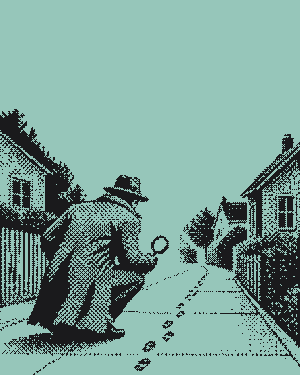
The Tracer follows money backwards. It works on a wallet, or on the deployer of a Pons V2 token.
- Freshness: the nonce the deployer used for its launch transaction says how many transactions it had sent before. A launch sent with nonce 0, 1 or 2 comes from a fresh wallet.
- Funding: it reads full blocks before the wallet's first known transaction (the launch for a deployer, the first USDG or WETH it received in about three weeks for a plain wallet) and keeps every plain ETH transfer into it. In a full case that window is 600 blocks, about one minute of chain time; ETH moved inside a contract call leaves no trace in a block body and is not seen.
- Hops: it follows the newest funder back up to three hops, labelling each one: a known contract, a verified contract by its Sourcify name, a high-volume wallet (2,000 transactions or more: an exchange, a bridge relayer or a market maker), or a wallet that has itself launched tokens on Pons V2.
- Shared funding: on a token case the same window is checked for transfers to the launch's early buyers. A deployer that funded early buyers, or one wallet that funded several of them, is filed as an alert.
No. 2, The Census

The Census counts who bought a Pons V2 launch and how. It reads every Transfer log of the token since its launch, up to 10,000.
- The launch buy: how much of the supply the launch transaction bought, and whether the tokens went to the deployer or to a second wallet.
- Snipe-tax exemptions: Pons V2 charges an opening snipe tax, and a creator may list wallets that skip it. The Census decodes that list from the launch call and checks whether those wallets bought.
- Bundles: buys in the launch block itself, and blocks in the first 300 (about thirty seconds) that carry buys from two or more wallets.
- Consolidation: early buyers (the first twenty distinct wallets, contracts such as routers left out) who later send their tokens to one common wallet.
- Holders: balances folded from the transfers, the share held by the ten largest wallets outside the curve and system contracts, and whether the creator has sold.
No. 3, The Locksmith

The Locksmith checks who holds keys to a contract.
- Source: whether Sourcify holds verified source for the address, and the contract's name.
- Upgrades: the EIP-1967 implementation, admin and beacon slots. A proxy can have every rule replaced by whoever controls the upgrade.
- Owner powers:
owner(), and privileged functions in the verified ABI (mint, blacklist, pause, fee and tax setters, upgrades, withdrawals). - On a Pons V2 token: the factory's record (phase, creator tax, fee recipient, buyback), a pending change of fee recipient, and how far the curve is from graduation, read from its reserves.
- A simulated sale: with
eth_simulateV1against the current state, the largest holder approves and sells a tenth of its bag back to the curve. On another token, a transfer of 1% of the largest visible holder's balance to a fresh address shows whether transfers revert or lose a fee on the way.
No. 4, The Archivist
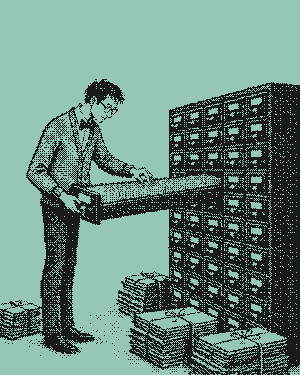
The Archivist keeps the history. It reads every TokenLaunched event the Pons V2 factory emitted for the same deployer, over the last 75 million blocks in a full case (back to the opening of Pons V2), and looks at the twelve most recent: the factory's phase for each, how far its curve got, and whether the deployer still holds any of it. A launch still on its curve a day later and under 3% of the way to graduation is counted as abandoned. Several launches a day, or a record that is mostly abandoned, is filed as a warning or an alert.
No. 5, The Night Watch
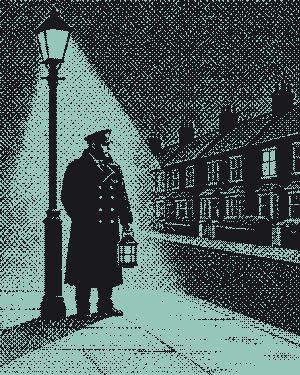
The Night Watch reads the factory every fifteen minutes and opens a public case on each new Pons V2 launch a few minutes after it happens. Its cases are lighter than a paid one: the Census, the Locksmith and an Archivist that looks back about twelve days, without the Tracer's block reading. They go straight to the board, in plaintext, and into the next anchor batch.
The summary
Every file ends with a written summary. Today it is written from the findings by a fixed template, the same words for the same evidence. When the protocol's Anthropic API key has credit, a paid case's summary is written by Claude from the findings alone, and the file says which model wrote it. Night Watch files always use the template. No confidential-computing (TEE) model is wired in at the moment.